UAE Best Driver Index: Which Emirate Has the Best Drivers?
The cost of a driving licence in Dubai depends on the type of licence you’re applying for, whether you’ve passed the first time, and your chosen driving institute. If you’re a first-time applicant, you may spend somewhere between AED 4,500 and AED 7,500. If you’re from the RTA’s list of approved countries and hold a valid licence, you may pay less because you don’t have to go through the full training route.
As a trusted RTA-approved driving institute, Bin Yaber works through the licence process with new students. Our daily experience reflects what learners actually pay, not just the advertised starting price.
Below is the full breakdown of a Dubai driving licence cost in 2026, based on current RTA fee schedules and current school rates in the emirate.
It’s not Dubai or Abu Dhabi.
Sharjah has the best drivers in the UAE. Abu Dhabi and Dubai rank second and third, followed by Ajman, Ras Al Khaimah, and Fujairah, which place fourth, fifth and sixth. Umm Al Quwain lands in last place.
The above ranking is based on the UAE Best Driver Index, a measure the Bin Yaber Driving Institute created to evaluate the quality of driving in the emirates, as indicated by how safe the roads are, how good and accessible driving schools are, how careful the drivers drive, and how successful drivers are at passing their driving tests.
To this end, we combined publicly available data on seven indicators grouped into four pillars, and we normalized and combined them as weighted scores. Higher overall scores indicate a better driving quality characterized by a stronger driving education ecosystem, safer roads, more cautious drivers, and better driving test outcomes.
Overall Ranking: UAE's Best Drivers by Emirate
Below is the overall ranking table of the emirates based on the UAE Best Driver Index scores.
| Emirate | Driving Education | Road Safety | Driving Behaviour | UAE Best Driver Score | Rank | ||||
|---|---|---|---|---|---|---|---|---|---|
| Number of driving schools | Average rating score | Number of reviews | Fatalities per 100,000 residents | Hit-and-run per 100,000 residents | Average speed (km/h) | Search volume for driving-test-failure terms | |||
| Sharjah | 56 | 4.55 | 40,007 | 1.78 | 5.33 | 31.6 | 0 | 84.4 | 1 |
| Abu Dhabi | 30 | 4.66 | 11,185 | 3.25 | 5.88 | 28.3 | 600 | 82.2 | 2 |
| Dubai | 94 | 4.58 | 50,818 | 4.22 | 10.11 | 32.1 | 396 | 80.3 | 3 |
| Ajman | 49 | 4.73 | 7,441 | 2.18 | 10.70 | 37.9 | 0 | 68.3 | 4 |
| Ras Al Khaimah | 55 | 4.51 | 3,996 | 8.70 | 8.41 | 36.2 | 0 | 61.8 | 5 |
| Fujairah | 2 | 4.26 | 754 | 4.68 | 13.27 | 38.1 | 0 | 42.9 | 6 |
| Umm Al Quwain | 11 | 4.33 | 1,627 | 36.62 | 34.58 | 34.03 | 0 | 17.6 | 7 |
1. Sharjah (84.4/100)
Sharjah leads the emirates, with an index score of 84.4 out of a possible 100.
Sharjah has many driving schools (56) with a solid review volume (40,007). It also has a good average rating score (4.55). That said, road safety is where Sharjah truly shines. It has the lowest number of fatalities (1.78) and hit-and-run incidents (5.33) per 100,000 residents.
Sharjah has the highest road safety composite score, which comprises 45% of its Best Driver Index score. Its average driving speed (31.6 km/h), which is at the safer end of the spectrum, also indicates a more cautious driving behaviour.
2. Abu Dhabi (82.2/100)
Abu Dhabi ranks second, with a score of 82.2 out of 100.
It is the emirate with the best driving behaviour, represented by its low 28.3 km/h average driving speed. Perhaps because of this, the emirate’s roads are relatively safe. Abu Dhabi has the next best road safety composite score among the emirates, with a distinctly low number of fatalities (3.25) and hit-and-run incidents (5.88) per 100,000 residents.
However, while its driving schools have the second highest average rating score (4.66), it lags behind Dubai, Sharjah, and Ras al Khaimah when it comes to the number of driving schools (30) and number of driving school reviews (11,185). Abu Dhabi also has the highest volume of online searches for driving test failure terms.
3. Dubai (80.3/100)
Dubai scores 80.3 out of 100.
Dubai has the best driving-education ecosystem in the UAE. With 94 driving schools, it has 67% more driving schools than Sharjah and 213% more driving schools than Abu Dhabi. The volume of Dubai’s driving school reviews is 50,818, with a strong average rating of 4.58; this review volume is 27% higher than Sharjah’s and 354% bigger than Abu Dhabi’s.
However, Dubai’s 4.22 fatalities and 10.11 hit-and-run incidents per 100,000 residents are rather middling and give the emirate only a median road safety score.
Its average speed (32.1 km/h) sits just below the median average speed. Dubai drivers tend to drive faster than drivers in Abu Dhabi and Sharjah. The emirate also has the second-highest search volume for driving-test-failure terms.
Note: Our driving school in Dubai, which has 21 branches and 15 kiosks across the emirate, is a central part of Dubai’s excellent driving education ecosystem. The 26 listings Bin Yaber has in Google Places have more than 8,500 ratings and an average rating of 4.65, higher than Dubai’s average rating score.
In fact, our median rating score is even higher at 4.7, while 4.8 is the most frequent review rating across Bin Yaber’s Google Places listings. The head office and main location of our driving school in Al Ruwayyah has 5,540 ratings with an average rating score of 4.6.
4. Ajman (68.3/100)
Ajman ranks fourth with a score of 68.3 out of 100.
The emirate sits solidly in the middle of the rankings for driving education, with median values for the number of driving schools and the number of reviews (driving education indicators). It has a respectable number of driving schools (49) and review volume (7,441), as well as the highest average rating score of any emirate (4.73).
However, while it has the second lowest fatality rate (2.18 fatalities per 100,000 residents), it has a less desirable hit-and-run incidence rate (above-median 10.70 hit-and-run incidents per 100,000 residents).
Compounding this (or perhaps one of the reasons for this) is Ajman’s average driving speed of 37.9 km/h. Ajman drivers tend to drive faster (or behave less cautiously) than all the other emirates except Fujairah.
5. Ras Al Khaimah (61.8/100)
Ras Al Khaimah, ranking fifth with a score of 61.8 out of 100, has a similar driving education accessibility and quality as Sharjah, with its 55 driving schools and an average rating score of 4.51, albeit with a much lower number of driving school reviews (3,996).
Ras Al Khaimah’s less-than-stellar road safety performance lets it down.
Although its hit-and-run incidence rate (8.41 hit-and-run incidents per 100,000 residents) is below the median, it performs worse in the much weightier fatality rate metric; its 8.7 fatalities per 100,000 residents is a little over twice the median value (Dubai’s fatality rate) and is the second highest in the UAE.
The average driving speed (36.2 km/h) of drivers in Ras Al Khaimah is also on the higher side, only slightly lower than the average speed in Fujairah (top place) and Ajman (second place).
6. Fujairah (42.9/100)
Fujairah scores 42.9 out of 100, which gives it sixth place in our UAE Best Driver Index. Incidentally, Fujairah was crowned the UAE’s most driver-friendly city in a past index ranking.
Its place near the bottom is primarily due to its minimal driving-education footprint; it has only two driving schools, 754 reviews, and a 4.26 average rating score, all of which are the lowest values in the driving education metrics.
The emirate’s roads are also not the safest, with above-median fatality and hit-and-run incidence rates. This corresponds to 4.68 fatalities and 13.27 hit-and-run incidents per 100,000 residents.
The average driving speed (38.1 km/h) checks out. The highest in the UAE, it confirms a tendency to drive less cautiously in Fujairah than in the other emirates.
7. Umm Al Quwain (17.6/100)
Umm Al Quwain, with a score of only 17.6 out of a possible 100, is in last place, a consequence of its bottom-ranking fatality and hit-and-run-incident rates. Specifically, Umm Al Quwain logs 36.62 fatalities and 34.58 hit-and-run incidents per 100,000 residents.
The emirate’s driving behaviour and driving education scores are not enough to pull up its rankings. Umm Al Quawain drivers tend to drive at 34.03 km/h, the UAE dataset’s median value. It also has only 11 driving schools, 1,627 ratings, and an average rating score of 4.33, all of which are the second-lowest values for the driving education pillar.
Caveat: It’s important to note that Umm Al Quwain’s per-capita fatality and hit-and-run incidence rates are overstated. The table will tell you Umm Al Quwain only has 18 fatalities and 17 hit-and-run accidents. It has low absolute values, but it registers the highest fatality and hit-and-run incidence rates.
This is the small-number problem. Because of the small population (49,159), every fatality increases the per-capita fatality rate by 2.034 per 100,000 residents. In contrast, every fatality in Dubai (with a population of 3,739,808) increases the per-capita fatality rate by only 0.027 per 100,000 residents.
In other words, a single fatality has a 74.33 times greater impact on Umm Al Quwain’s fatality rate than Dubai’s.
The small-number problem is skewing the road safety scores not only for Umm Al Quwain but also for the other smaller emirates: Fujairah (population: 256,256), Ras Al Khaimah (population: 345,000), and Ajman (population: 504,846).
That said, if the values were shrunk empirically to reduce artificial spikes, Sharjah would still have the best driving quality, and Umm Al Quwain would still place last in this comparison.
However, the less exaggerated fatality and hit-and-run incidence rates for Umm Al Quwain would shrink the scale and flatten the road safety and index scores of all the emirates except Sharjah and Umm Al Quwain, painting a truer picture of road safety in the UAE.
Which Emirate’s Drivers Are Most Likely to Flee a Crash?
Based solely on the per-capita hit-and-run incidence rate (34.58 per 100,000 residents), Umm Al Quwain drivers are most likely to flee a crash. However, we know this figure is exaggerated by its small population; in truth, Umm Al Quwain has the lowest number of hit-and-run incidents (17).
Looking only at absolute values, we can see that Dubai has the highest number of hit-and-run incidents (378). This is followed by Abu Dhabi (223).
Consistent with Sharjah’s top-notch road safety rankings, drivers in Sharjah are less likely to flee the scene of a crash (5.33 hit-and-run incidence rate per 100,000 residents).
| Rank | Emirate | Hit-and-run per 100,000 | Hit-and-run accidents (count) | Population |
|---|---|---|---|---|
| 1 | Sharjah | 5.33 | 96 | 1,800,000 |
| 2 | Abu Dhabi | 5.88 | 223 | 3,789,860 |
| 3 | Ras Al Khaimah | 8.41 | 29 | 345,000 |
| 4 | Dubai | 10.11 | 378 | 3,739,808 |
| 5 | Ajman | 10.7 | 54 | 504,846 |
| 6 | Fujairah | 13.27 | 34 | 256,256 |
| 7 | Umm Al Quwain | 34.58 | 17 | 49,159 |
Conclusion
For exceptional driving quality, an emirate needs both an excellent driving education ecosystem and excellent road safety. Drivers must be more careful on the road, as evinced by lower average driving speeds. They should also be so well-trained and prepared they’re likely to pass their driving tests (and unlikely to search driving-test-failure terms online).
Sharjah fulfills these criteria. Due to its excellent road safety record and considerable driving education footprint, it lands in the top position of the UAE Best Driver Index.
Among the emirates, Dubai has the best driving education ecosystem, ranking first in the number of driving schools and review volume. With such infrastructure in place, it is in a very good position to grab first or second place.
Unfortunately, the sheer number of vehicles (3.5 million in the daytime) and the numerous drivers applying for a light motor vehicle license in Dubai naturally mean a commensurately high number of vehicular accidents, lowering its road safety score. Dubai has, in fact, the highest number of hit-and-run incidents and fatalities in the UAE.
Abu Dhabi drivers excel in driving behaviour. However, its low typical driving speed is more a function of its strict traffic control measures, zero-buffer policy on speed limits, and dynamic speed-limit throttling than anything else. In other words, Abu Dhabi’s drivers are well-behaved because the emirate has a system in place to force good driving behaviour.
The Best Driver Index scores of Ajman, Ras Al Khaimah, Fujairah and Umm Al Quwain could be better.
Ajman and Ras Al Khaimah have a solid number of driving schools with a good average rating score and a good volume of reviews. However, the highly weighted road safety score (a median hit-and-run incidence rate for Ajman and a median fatality rate for Ras Al Khaimah) puts them squarely in the middle.
Fujairah and Umm Al Quwain, meanwhile, have relatively low fatality and hit-and-run numbers, but having very few driving schools means a severe lack of supporting driver education infrastructure.
Note that a low population acutely amplifies the impact of every fatality and hit-and-run crash on per-capita fatality and hit-and-run incidence rates. This is what happens to Umm Al Quwain and, to a lesser extent, Fujairah, Ras Al Khaimah, and Ajman.
Methodology
The UAE Best Driver Index ranks the UAE's seven emirates: Dubai, Abu Dhabi, Sharjah, Ajman, Ras Al Khaimah, Fujairah, and Umm Al Quwain, on driving education quality, road safety, driving behaviour, and public interest in driving-related topics.
The higher an emirate's score, the stronger its driving education ecosystem, the safer its roads, and the more cautious its drivers.
The index is built from four pillars, each weighted according to its impact on road safety outcomes:
- Road safety (45%): Fatalities and hit-and-run accidents per 100,000 residents in 2024
- Driving education (30%): Number of driving schools, average review rating, and review volume, based on Google Maps data
- Driving behaviour (20%): Average driving speed in 2024
- Learning interest (5%): Annual search volume for driving-test-failure terms, such as ‘fail driving test’, ‘fail RTA test’ and ‘retake driving test’, reflecting how often residents search for help retaking their test, which can represent how successful driving test takers are
Each metric is standardised to a 0-100 scale relative to the other emirates, so the best-performing emirate scores 100 and the weakest scores zero. These standardised scores are weighted and then combined to produce a single UAE Best Driver Score that ranks the emirates from first to seventh place.
Road Safety carries the greatest weight because it reflects the most direct, real-world consequence of driving quality. Learning Interest carries the least weight, as search-volume data is a softer, more indirect signal of driving competence compared to actual fatality and accident data.
Data sources: Google Maps listings contributed driving school data. Official records for 2024 provided road safety, population, and speed data. Google Keyword Planner, Semrush, and Mangools provided keyword search volumes.
About Bin Yaber Driving Institute
Bin Yaber Driving Institute is a leading driving school in Dubai, known for its spacious and modern facility, new equipment, over 400+ vehicles, multi-lingual driving instructors, and small learning classes that provide individualised attention to driver-learners. We produce responsible drivers adhering to international standards to ensure road safety for all.
Learn more at www.binyaber.com.
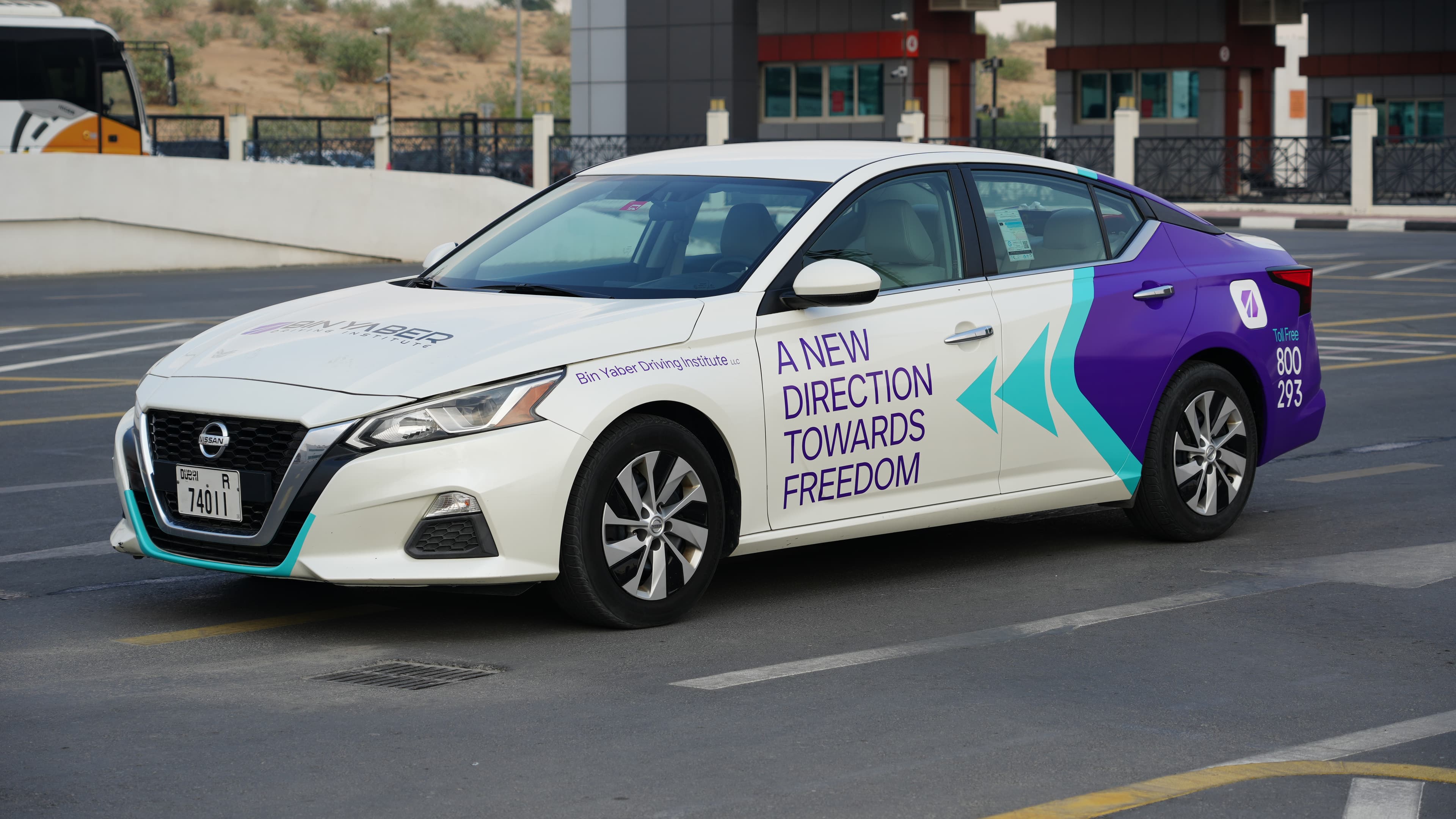
Ready to Hit the Road? Book Your Lessons Today!
Start your journey to safe driving! Book your lessons with Bin Yaber today and drive with confidence.