RTA Parking Test Dubai: Common Mistakes and How to Avoid Them

Passing the knowledge test is a major step, but the practical stage brings a different challenge. During the Roads and Transport Authority (RTA) yard test in Dubai, seemingly minor lapses in judgement or execution can affect the result, even when you understand the manoeuvre itself.
Understanding where learners commonly go wrong can make practice more focused. At Bin Yaber Driving Institute, we see how small differences in positioning, timing, and vehicle control can shape a learner’s performance during practical training.
This guide explains the mistakes to watch for across the Smart Yard manoeuvres and how to prepare more effectively for test day.
Key Takeaways
- The RTA Smart Yard test uses automated sensors to assess accuracy in five key manoeuvres, making precise vehicle control essential.
- Common failures often stem from poor initial positioning, incorrect steering timing, or over-reliance on fixed reference points instead of real-time awareness.
- Target your weak areas through deliberate practice instead of repeatedly running the full test.
What Is the RTA Smart Yard Parking Test in Dubai?
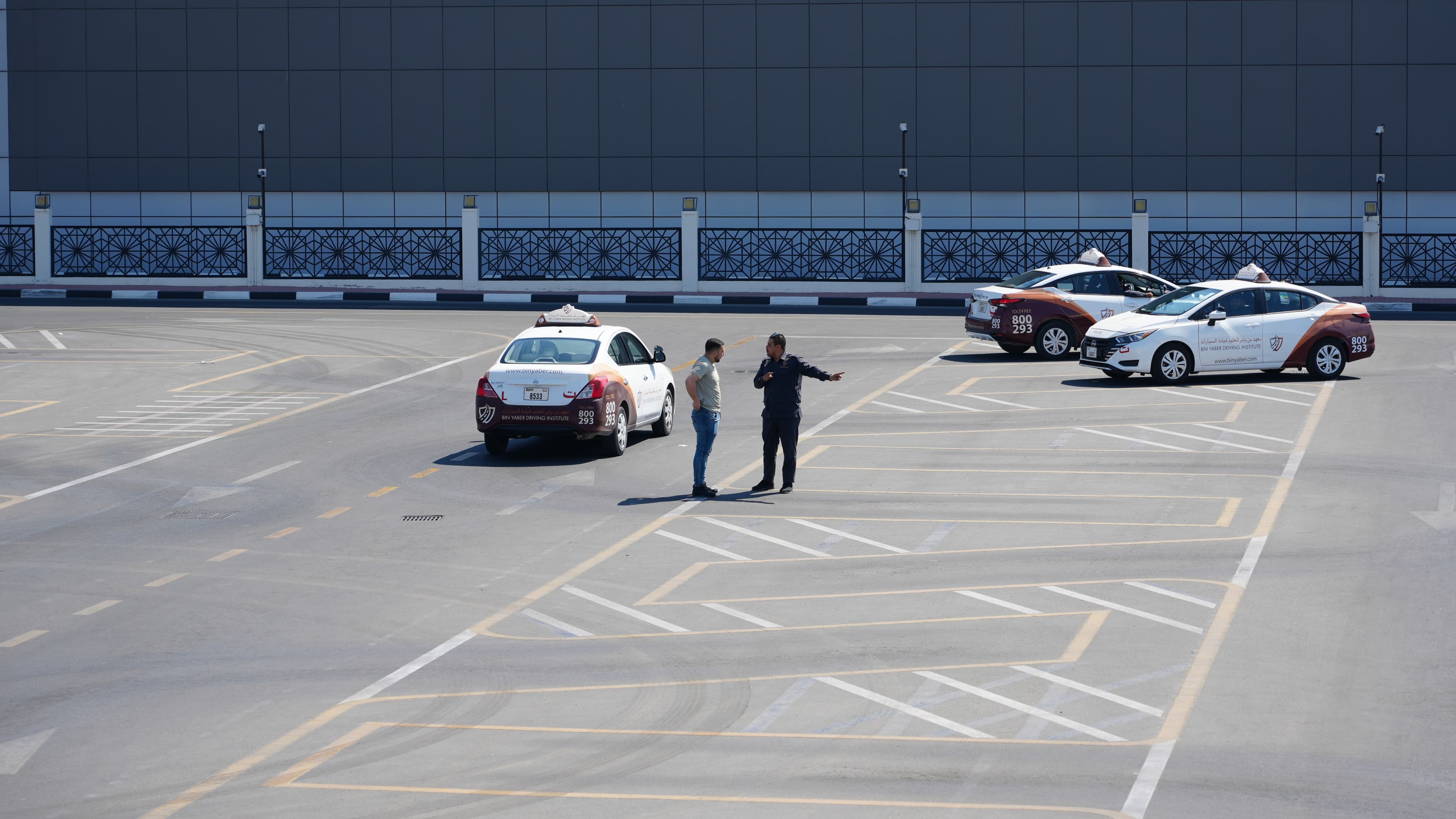
The Smart Yard test in Dubai is the practical assessment stage that comes after the theory test and before the final RTA road test. For light vehicle learners, the Yard Test covers five manoeuvres: parallel parking, 60-degree angle parking, garage parking, slope parking, and emergency braking.
Unlike a conventional examiner-led assessment, the Smart Yard uses cameras, sensors, and automated systems to record how the vehicle responds during each manoeuvre. This makes consistent execution especially important, as the assessment focuses on how accurately and safely you complete each task.
If you are working toward passing the RTA parking test on your first attempt, your practice should focus on accurate positioning, controlled steering, and repeatable technique.
Common Mistakes That Cause Problems in the RTA Parking Test
Each manoeuvre has its own challenging points, and small errors can build quickly once the vehicle is out of position. Here are some mistakes learners should watch for across the different components of the Yard Test:
Parallel Parking: Starting or Turning at the Wrong Point
For parallel parking in the RTA test, problems often begin before the car is fully committed to the manoeuvre.
- Starting too close to or too far from the parking space can throw off the rest of the steering sequence.
- Turning too early or too late can leave the vehicle poorly aligned.
Reference points can help, but they work best when paired with an awareness of the vehicle’s actual position. Keep checking the kerb, parking boundaries, and vehicle angle rather than relying on one memorised visual cue alone.
Garage Parking: Misjudging the Bay and Vehicle Alignment
During the garage parking test, the starting position strongly influences how smoothly the vehicle enters the bay.
Common mistakes that can send the car into the bay at an incorrect angle include:
- Beginning too close to or too far from the space
- Turning at the wrong point
- Oversteering
Watch both mirrors as you reverse and use them to judge how evenly the vehicle is entering the space. If the alignment already looks wrong, understanding why it happened during practice is more useful than simply repeating the same sequence.
For a closer look at the technique, see Bin Yaber’s garage parking guide.
Angle Parking: Entering at the Wrong Position or Angle
RTA identifies 60-degree angle parking as one of the five Yard Test components. In this manoeuvre, an incorrect approach can make the rest of the manoeuvre harder. Steering too early or too late may leave the car angled incorrectly or positioned too close to one side of the bay.
Avoid judging the manoeuvre from the front of the vehicle alone. Use the mirrors to monitor how the car moves into the space and whether it stays properly aligned within the parking boundaries.
Slope Test: Losing Control on the Slope
In the slope test, a common difficulty is maintaining control as the vehicle stops and moves away on the incline.
Allowing the car to roll or rushing the transition between stopping and moving can disrupt the manoeuvre. During practice, focus on coordinating the vehicle controls smoothly and following the same routine each time rather than trying to complete the exercise quickly.
Emergency Braking: Reacting Incorrectly or Too Slowly
With sudden braking, the goal is not simply to brake hard, but to respond correctly while keeping the vehicle under control.
The system checks your reaction time, and a delayed response, incorrect braking technique, or loss of steering control can affect the assessment. Practise the sequence as instructed during your lessons so that the response feels familiar rather than something you have to work out under test conditions.
Why Do Learners Make These Mistakes Even After Practising?
Knowing the steps of a manoeuvre does not always mean you can repeat it consistently under test conditions. In many cases, the problem comes from how the learner practises, not from a lack of understanding. Test-day tension can also lead to mistakes. During practice, the instructor is beside the learner, but during the test, the learner is alone in the vehicle and must perform independently.
Relying Too Heavily on Reference Points
Reference points can make parking easier to learn, but they are not universal. Your seating position, mirror setup, and even height can affect what you see.
Use them as guides rather than fixed rules. The aim is to understand how each cue relates to the car’s position, so you can recognise when the vehicle is no longer following the expected path.
Rushing or Overcorrecting
Nervousness can make learners move through the sequence too quickly, steer more sharply than usual, or make unnecessary corrections after a small mistake.
Try to keep the same controlled pace you use during lessons. If something feels slightly off, focus on the vehicle’s position before making another input instead of reacting immediately.
Practising the Whole Test Instead of the Weak Manoeuvre
How should you practise for the RTA parking test before your appointment? It shouldn’t only involve repeatedly running through every component, as this can leave a recurring problem unresolved.
If one manoeuvre keeps going wrong, identify the specific cause first. It may be the starting position, steering timing, speed, alignment, or observation. Once you know what is causing the error, you can practise that part more deliberately before putting the full sequence together again.
Frequently Asked Questions
Which parking manoeuvres are included in the RTA yard test?
The RTA Yard Test includes five components: parallel parking, 60-degree angle parking, garage parking, slope test, and emergency braking test. The first three assess your ability to position and control the vehicle within designated parking spaces, while the slope and braking exercises test control in other practical situations.
How can I pass parallel parking, garage parking, and angle parking?
Focus on consistent positioning, controlled steering, and awareness of the vehicle’s alignment rather than memorising reference points alone. Practise each manoeuvre until you understand how your starting position and steering timing affect the result, then work specifically on any part that remains inconsistent.
How much time do I get for each parking manoeuvre?
Published Dubai driving-institute assessment criteria allow up to 5 minutes for parallel parking, 3 minutes for garage parking, and 2 minutes for 60-degree angle parking. Exceeding these limits is listed as an immediate failure, so practise completing each manoeuvre accurately without unnecessarily slowing the sequence.
Take Your RTA Parking Test With Confidence
The most useful Dubai parking test tips are not shortcuts. They help you understand where mistakes begin and make your technique more consistent through focused practice. Work on the manoeuvres that still cause difficulty, follow the technique taught during your lessons, and aim for controlled execution rather than perfection under pressure.
When you are ready for more practical guidance, explore Bin Yaber Driving Institute’s driving courses and training options.


Ready to Hit the Road? Book Your Lessons Today!
Start your journey to safe driving! Book your lessons with Bin Yaber today and drive with confidence.